Some films are difficult because they’re confusing. Some are difficult because they’re violent or disturbing. Taste of Cherry is difficult in a completely different way — it’s difficult because it sits quietly next to a man who wants to end his life and asks you, without melodrama or manipulation, to simply be there with him. And somewhere in that quiet sitting-together, something unexpected happens. It becomes one of the most life-affirming films you’ll ever see. Abbas Kiarostami was a genuine miracle worker.
Note: This film deals directly with suicidal ideation. The article discusses it in a film criticism context, but if you’re going through something difficult personally, please reach out to someone you trust or a crisis support service.
The Basics
- Title: Taste of Cherry (طعم گیلاس / Ta’m e guilass)
- Year: 1997
- Director: Abbas Kiarostami
- Producer: Abbas Kiarostami
- Screenplay: Abbas Kiarostami
- Stars: Homayoun Ershadi, Abdolrahman Bagheri, Afshin Khorshid Bakhtiari, Ali Moradi
- Cinematography: Homayoun Payvar
- Runtime: 95 minutes
- Genre: Drama
- Country: Iran
- Studio: Abbas Kiarostami Productions / CiBy 2000
Source: IMDB
What Is Taste of Cherry (1997) About?
Mr. Badii (Homayoun Ershadi) drives his Range Rover through the dusty outskirts of Tehran, stopping to talk to strangers — men on the roadside looking for work, men sitting in the heat. He offers them a job. A simple one, he says. He needs someone to come to a specific spot outside the city the following morning, call his name twice, and if he doesn’t respond, cover him with dirt. He’s going to take sleeping pills that night and lie down in a hole he’s already dug. He’ll either be dead in the morning, or he won’t. Either way, he just needs someone to cover him.
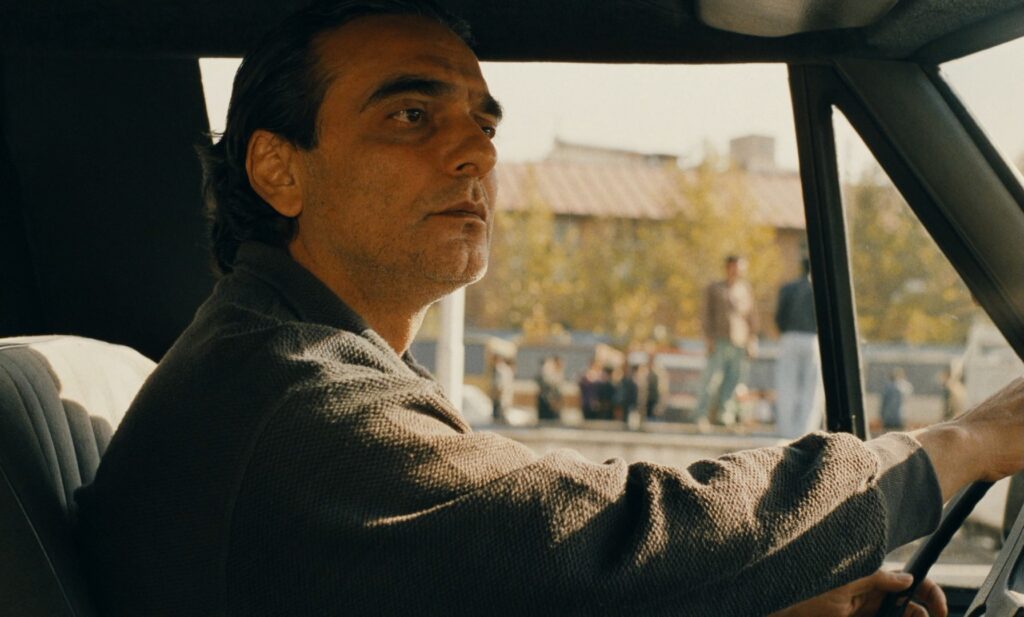
That’s the entire plot. Mr. Badii drives. He talks to three different men. A young Kurdish soldier who panics and runs. An Afghan seminary student who tries to reason with him from a religious perspective. And finally an older Turkish taxidermist named Mr. Bagheri — who agrees to help, and who in the course of their conversation says things that neither Mr. Badii nor the audience quite expect.
We never find out why Mr. Badii wants to die. He doesn’t explain and Kiarostami doesn’t make him. We don’t know his past, his circumstances, his relationships. All we know is what we see: a man driving through a landscape, asking for help with the last thing he wants to do.
The Quiet Devastation of Kiarostami’s Storytelling
Kiarostami refuses to give you easy handles. Most films about suicide either aestheticize the tragedy or moralize against it. Taste of Cherry does neither. It doesn’t frame Mr. Badii as mentally ill, as a cautionary tale, as a mystery to be solved, or as a victim to be pitied. It simply puts him in front of you and lets him exist — a real, specific, quiet person who has made a decision and is trying to carry it out with the same practical seriousness he’d bring to any other task. By refusing to explain or judge Badii, Kiarostami treats both his protagonist and the viewer with rare respect.
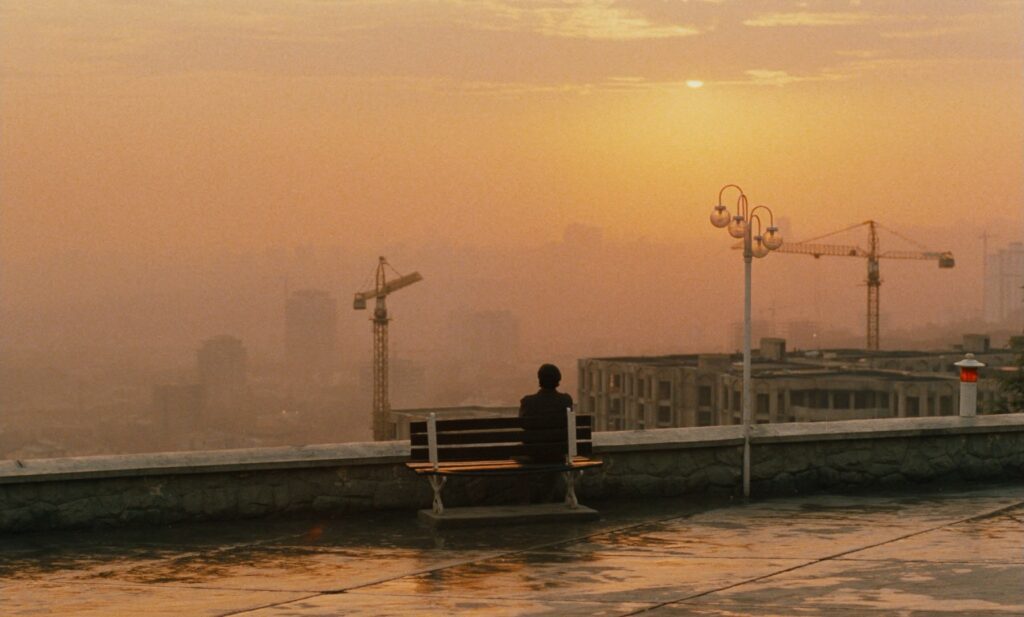
The setting does enormous emotional work. The film is almost entirely shot in and around Mr. Badii’s car, driving through the arid construction sites and dusty hillsides on the outskirts of Tehran — landscapes that feel both barren and alive, ugly and quietly beautiful. Kiarostami frames the world outside the car window with a painter’s eye, and you keep noticing — as Mr. Badii perhaps cannot — how insistently present the world is. The light changing. Workers moving. Birds circling. Life happening indifferently everywhere around a man who wants to leave it. For another road movie that turns quiet observation into deep emotion, see our piece on Paris, Texas (1984).
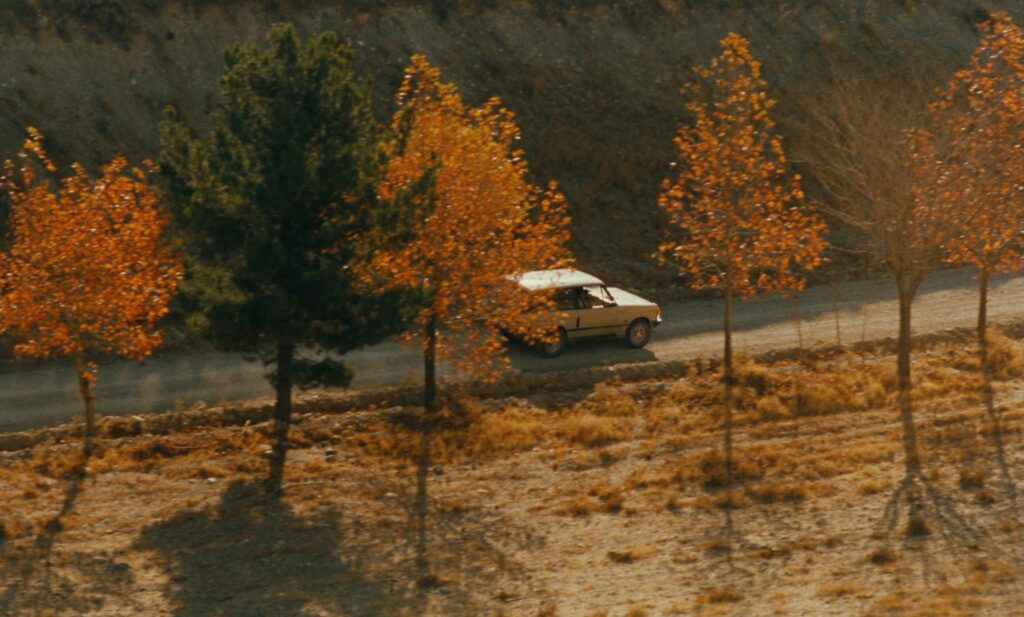
The three conversations are structured like a philosophical argument. The soldier represents instinct — he simply can’t engage with the request and flees. The seminary student represents faith — he argues against suicide from a religious standpoint, sincerely and gently. And then Mr. Bagheri, the taxidermist, represents something more complicated: lived experience. He tells Mr. Badii about the time he himself stood at the edge and what changed his mind. It wasn’t an argument. It wasn’t theology. It was a mulberry tree and the taste of its fruit and the way the morning looked and the simple, stubborn fact of still being in the world.
That mulberry tree conversation is one of the great scenes in world cinema. Mr. Bagheri, in the car with Mr. Badii as the light goes golden and warm, talks about the morning he was going to end his life — how he reached up to grab a branch to steady himself and mulberries rained down on him, and children came running for them, and he tasted one, and somehow that was enough. Not a revelation. Not a reason. Just a taste. Just the world being there, insisting on itself. On paper, the scene sounds almost too simple. On screen, it lands with unforgettable force.
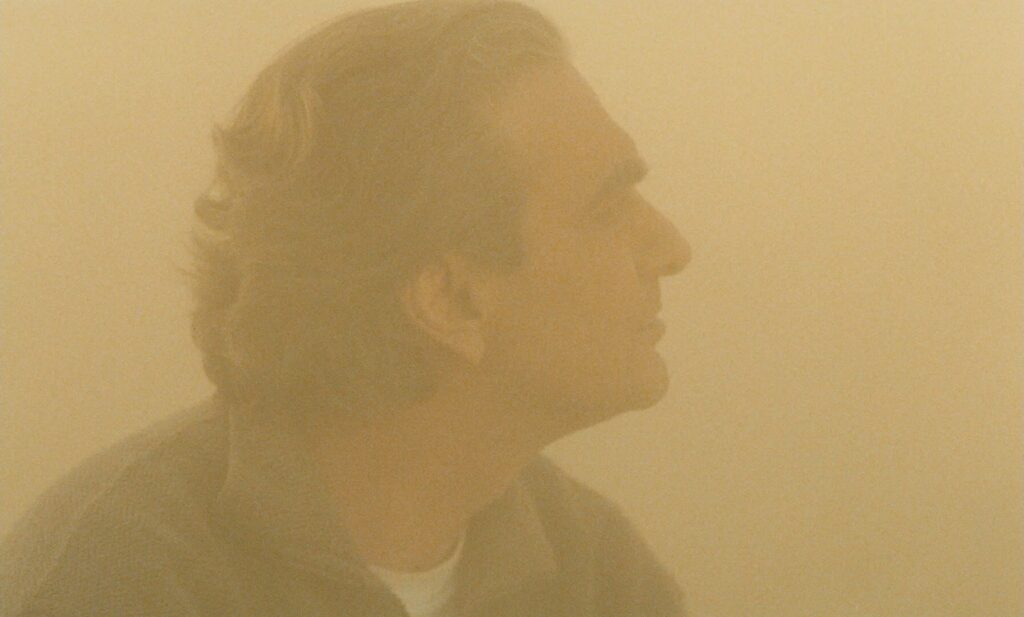
Homayoun Ershadi carries the film on absolute stillness. Ershadi — a non-professional actor Kiarostami spotted in traffic — plays Mr. Badii with an almost total absence of expressiveness that is somehow the most expressive thing in the film. He’s not withdrawn in an actorly way. He just is — present, specific, impossible to read and therefore impossible to look away from. His stillness creates a vacuum the audience fills with their own feelings, and that’s where the film lives.
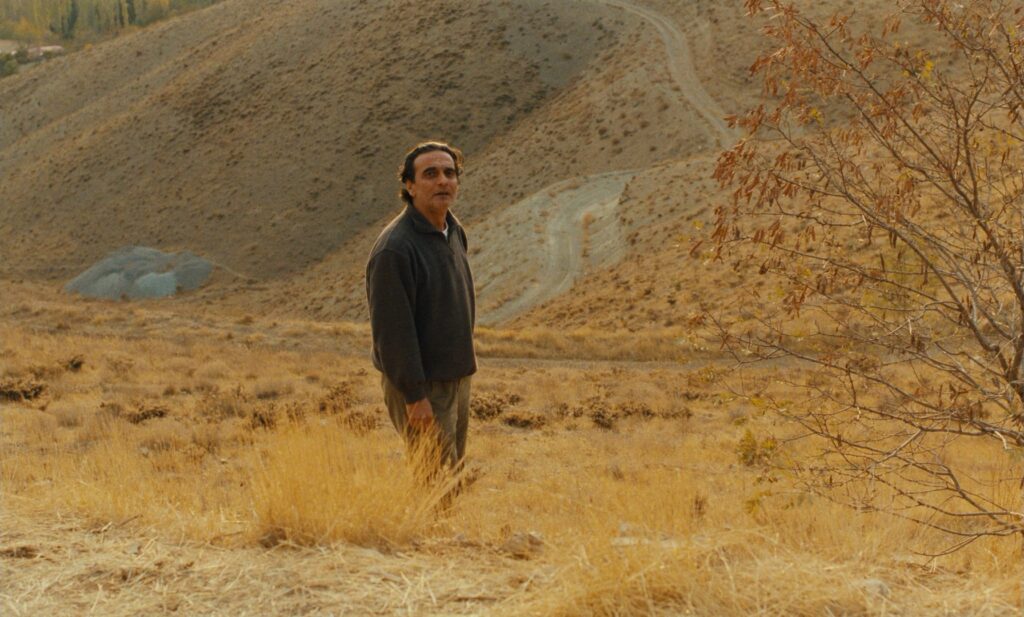
The ending is one of the most debated in cinema. Without describing it in detail — the film ends in a way that ruptures the reality it has spent 90 minutes carefully constructing, pulling back from its own world in a gesture that is either deeply alienating or deeply liberating depending on who you are and what you bring to it. It’s Kiarostami saying something explicit about cinema itself, about the relationship between filmmakers and the people they film, about the distance between art and life. People argue about it constantly. Kiarostami leaves the door open—forcing us to bring our own answers to the table.
The Reception
Taste of Cherry won the Palme d’Or at Cannes in 1997 — sharing the prize with The Eel by Shohei Imamura — and the win was controversial in the way only Cannes wins can be. Some critics felt the film was too austere, too withholding, too minimal to deserve cinema’s highest honor. Others felt it was exactly the kind of film that honor exists for.
The controversy settled in the film’s favor. Over the decades, Taste of Cherry has come to be recognized as one of Kiarostami’s definitive achievements and one of the essential films of world cinema — a film that appears regularly on critics’ polls of the greatest films ever made and that has influenced filmmakers from Jafar Panahi to Hou Hsiao-hsien to Jim Jarmusch.
It was also a significant political moment: made in Iran under conditions of considerable artistic restriction, the film was initially not even allowed to be submitted as Iran’s official entry to the Academy Awards. Kiarostami’s ability to make something so quietly radical within those constraints speaks to both his artistry and his stubbornness.
The Legacy
Taste of Cherry is central to any serious discussion of Abbas Kiarostami’s work — a filmmaker who spent his career dismantling the boundaries between documentary and fiction, between the frame and what’s outside it, between the filmmaker and his subjects. The film carries all of those concerns to one of their most fully realized expressions.
It also represents a particular kind of Iranian cinema — humanist, philosophically serious, visually rooted in landscape — that Kiarostami almost singlehandedly brought to international attention and that influenced an entire generation of Iranian filmmakers who followed him.
Beyond Iran, the film is frequently discussed in philosophy courses as a meditation on the will to live, the contingency of life, and the question of what — if anything — we owe to ourselves and to the world. That it does all this through a man driving a car and talking to strangers is the most Kiarostami thing possible.
Should You Watch It?
Taste of Cherry is not for every mood or every moment. It’s a quiet film about a heavy subject and it doesn’t offer comfort in the conventional sense — it doesn’t resolve neatly, doesn’t provide answers, and will frustrate viewers who need narrative momentum or emotional catharsis to feel a film has “worked.”
But if you can meet it on its own terms — if you’re willing to sit with uncertainty and absence and the particular quality of attention this film asks for — it offers something rare. A film that looks directly at the desire to leave the world and finds, in doing so, all the small specific reasons the world is worth staying for. The mulberries. The morning light. The taste of something sweet you didn’t expect.
Watch it on a day when you have space to think afterward. And pay attention to the light on the hills outside the car window. It’s trying to tell you something.
“Have you ever tasted a mulberry? Have you ever picked mulberries? Come with me. Come and see the mulberries.”
— Mr. Bagheri, Taste of Cherry