
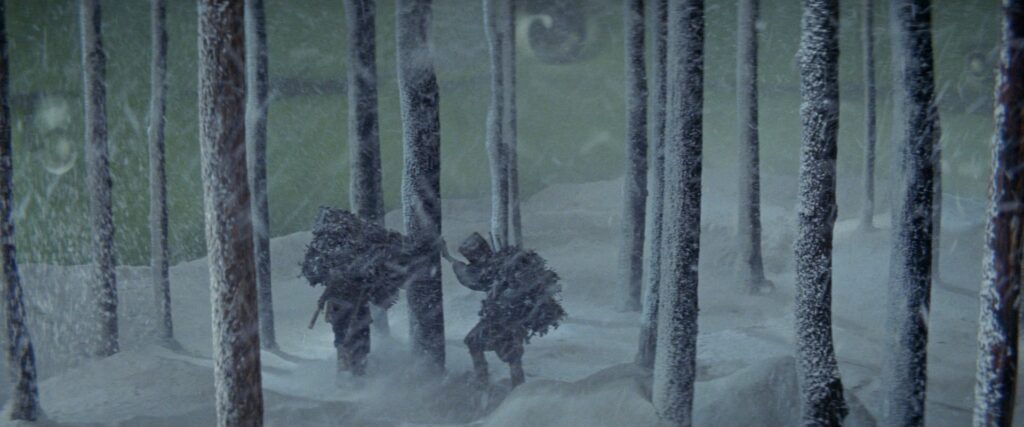
If you’ve ever wanted a horror movie that feels like walking through a moving painting — slow, eerie, and so visually stunning you’ll forget to be scared and just be in awe instead — Kwaidan (1964) is that movie. It’s not horror in the modern jump-scare sense. It’s more like four classic Japanese ghost stories brought to life through some of the most striking set design ever put on film.
The Basics
- Title: Kwaidan (怪談 / Kaidan, meaning “Ghost Stories”)
- Year: 1964
- Director: Masaki Kobayashi
- Producer: Shigeru Wakatsuki
- Screenplay: Yōko Mizuki, based on stories collected by Lafcadio Hearn
- Stars: Rentarō Mikuni, Michiyo Aratama, Tatsuya Nakadai, Keiko Kishi, Katsuo Nakamura
- Cinematography: Yoshio Miyajima
- Music: Tōru Takemitsu
- Runtime: 183 minutes (original cut) / often shown around 161 minutes
- Genre: Horror / Anthology / Fantasy
- Country: Japan
- Studio: Toho / Ninjin Club
What Is Kwaidan (1964) About?
Kwaidan is an anthology film made up of four separate, unconnected ghost stories, all based on traditional Japanese folktales compiled by the writer Lafcadio Hearn (a Greek-Irish writer who settled in Japan and became deeply immersed in its folklore).
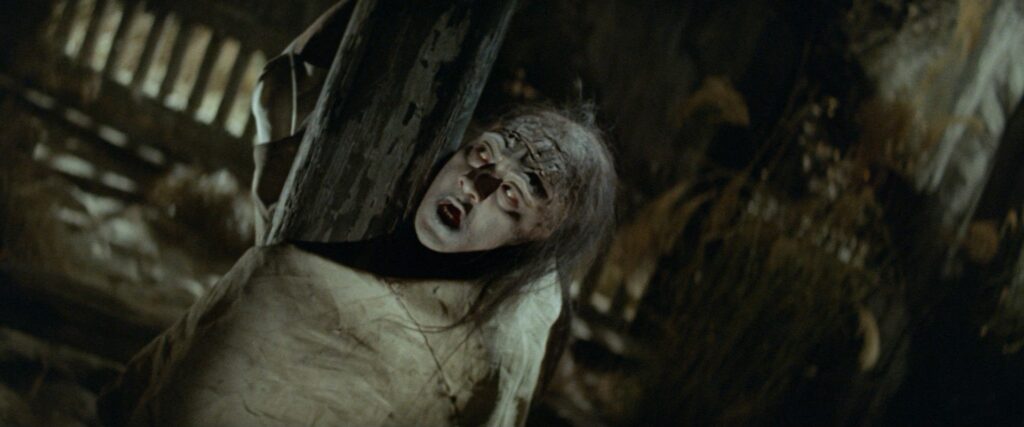
“The Black Hair” follows a samurai who abandons his loyal wife for a more advantageous marriage, only to be haunted by guilt and something far more literal when he eventually returns home.
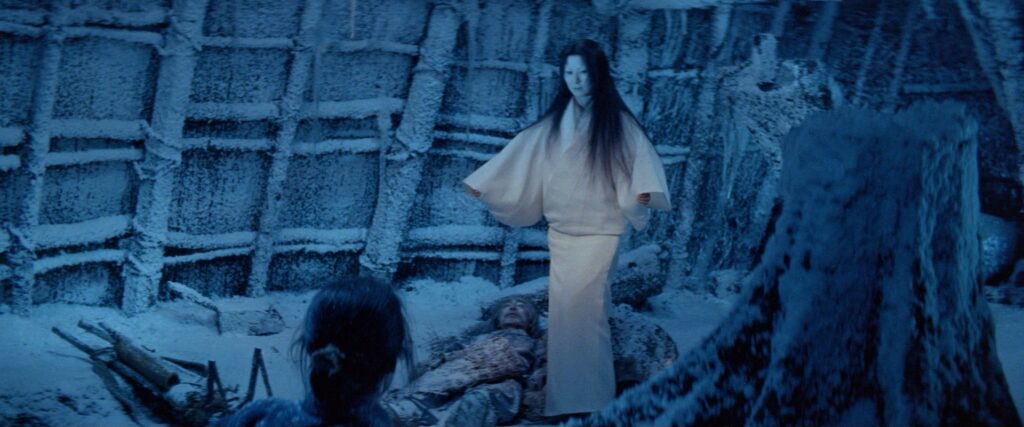
“The Woman of the Snow” tells of a young woodcutter who survives an encounter with a ghostly, pale spirit in a snowstorm — under the condition that he never speaks of what happened. Naturally, keeping that promise turns out to be harder than expected.
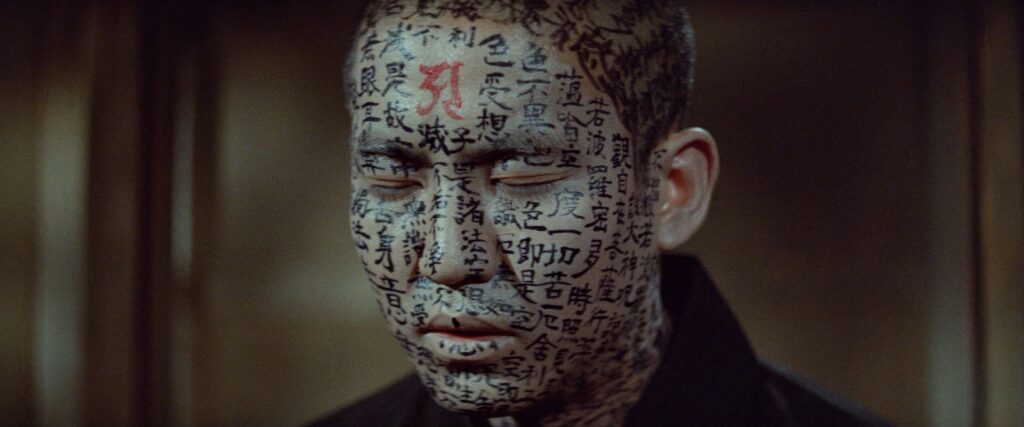
“Hoichi the Earless” — probably the most famous segment — follows a blind musician who’s mysteriously summoned each night to perform for what he believes is a noble audience, but is actually something much stranger and more dangerous, tied to a historic, bloody sea battle.
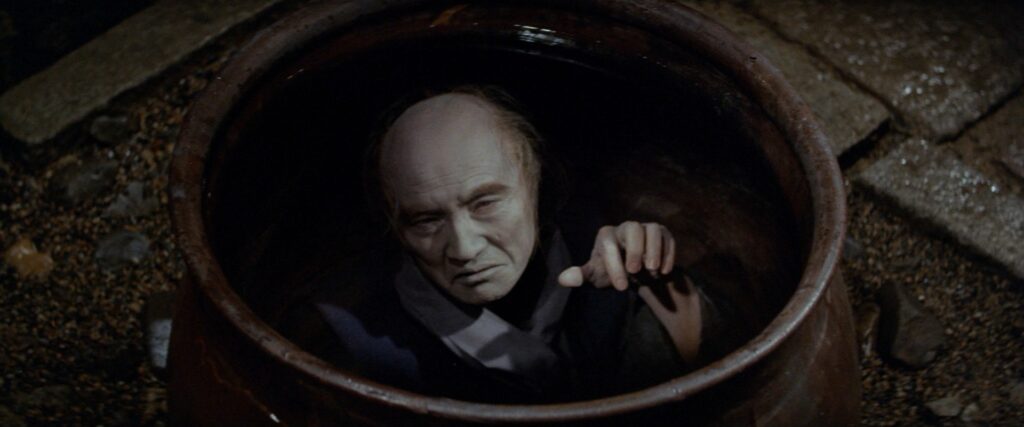
“In a Cup of Tea” is the shortest and strangest of the four, about a writer who keeps seeing a man’s reflected face in his cup of tea — and what happens after he doesn’t take that nearly seriously enough.
Each story is self-contained, slow-building, and more interested in dread, guilt, and tragedy than in shocking you outright.
Why Kwaidan (1964) Is Such a Visual Masterpiece
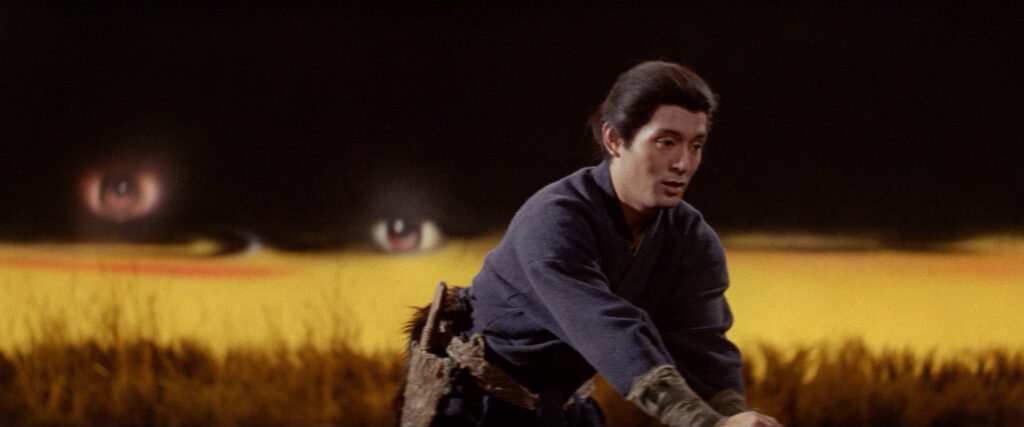
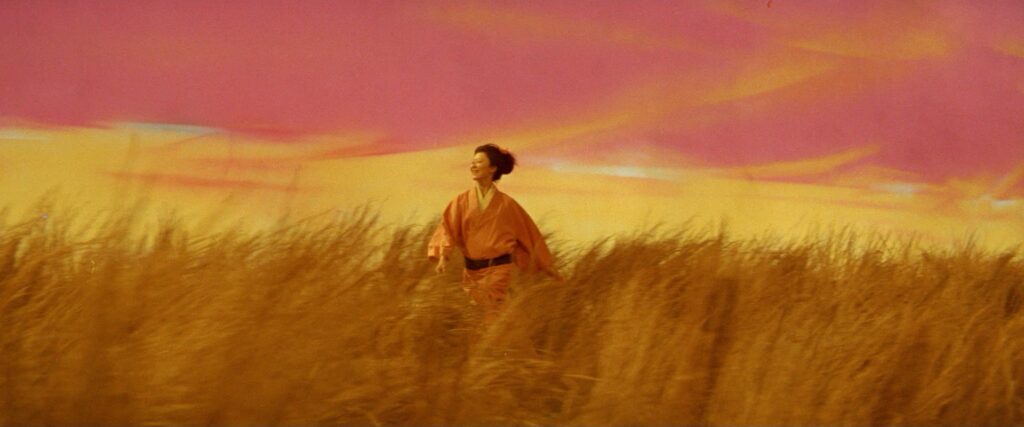
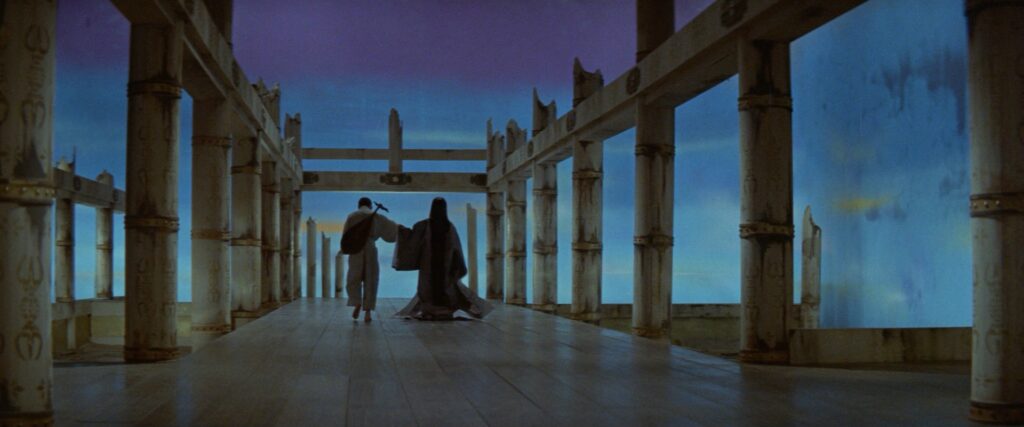
The sets are entirely artificial, and that’s exactly what makes them so striking. Director Masaki Kobayashi shot the entire film on enormous soundstages with deliberately painted backdrops — skies with giant unblinking eyes, swirling clouds, unnaturally colored landscapes. Nothing here is trying to look “real.” Instead, it creates this constant feeling that you’re inside a moving ukiyo-e woodblock print or an illustrated scroll. It’s theatrical and dreamlike in a way that’s genuinely unlike anything else in horror cinema.
Tōru Takemitsu’s sound design is doing something extraordinary. Rather than a traditional musical score, Takemitsu built much of the soundscape from unconventional, percussive, almost alien sounds — silences stretched uncomfortably long, single jarring notes, wind, breathing. It creates a constant unease that a normal orchestral score never could.
Every frame looks like it was composed by a painter, not a cinematographer. Yoshio Miyajima’s cinematography leans heavily into color symbolism — deep reds, cold blues, eerie golds — used not for realism but for emotional and symbolic weight. The “Woman of the Snow” segment in particular uses color and lighting to create one of the most visually hypnotic sequences in Japanese cinema.
“Hoichi the Earless” is a masterclass in slow-building dread. This segment alone runs close to an hour and builds an atmosphere of creeping horror almost entirely through stillness, ritual, and repetition — the blind musician walking the same path each night, never quite understanding the danger he’s in. It’s often singled out as the emotional and artistic high point of the film.
It’s deeply rooted in real Japanese folklore and Buddhist themes of karma, guilt, and the consequences of broken promises. Each story ultimately punishes characters not for being evil, but for small human failures — vanity, fear, forgetting a vow. That moral weight gives the horror a quiet, almost philosophical sadness underneath the supernatural scares.
The Reception
Kwaidan premiered at the Cannes Film Festival in 1965, where it won the Special Jury Prize — a significant international recognition for a Japanese horror anthology at the time. It was also nominated for the Academy Award for Best Foreign Language Film, helping bring serious international attention to Japanese genre filmmaking beyond the more famous samurai and Godzilla films of the era.
Critically, the film has only grown in stature over the decades. It currently holds very strong acclaim among classic film and horror enthusiasts and is frequently included on lists of the greatest horror films and greatest Japanese films ever made. Its visual style in particular is constantly singled out by critics and filmmakers as one of the most distinctive achievements in the genre. The film’s enduring reputation has also been reinforced through its beautifully restored release by the Criterion Collection, introducing this Japanese horror masterpiece to new generations of film lovers around the world.
The Legacy
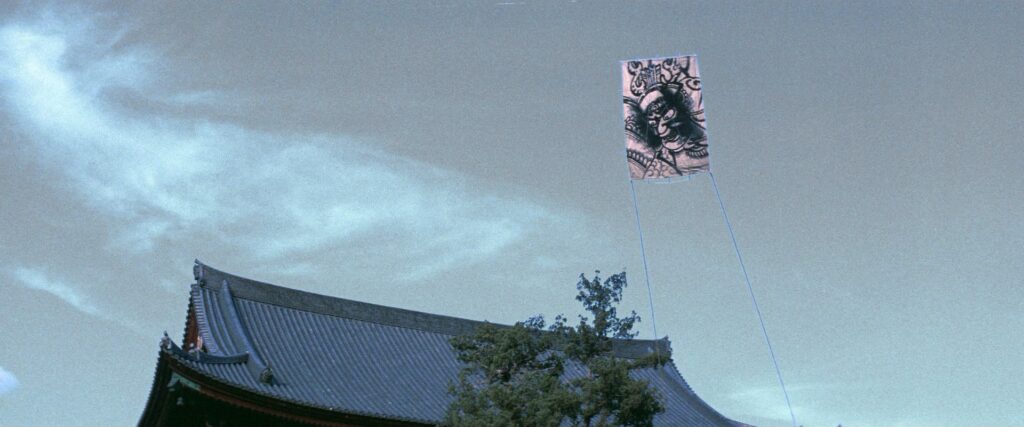
Kwaidan helped establish Masaki Kobayashi as one of the major Japanese directors of his generation, alongside contemporaries like Akira Kurosawa and Kenji Mizoguchi, even though Kobayashi’s filmography (including Harakiri, made just a year earlier) tends to skew more toward intense, morally complex drama than horror specifically.
The film is frequently cited as a major influence on later anthology horror and on filmmakers interested in theatrical, stylized visual approaches to fear — proof that horror doesn’t need realism to be effective; sometimes artificiality and stylization can create dread just as powerfully, if not more so.
It’s also become one of the more accessible entry points into classic Japanese horror for international audiences, frequently recommended alongside Onibaba and Ugetsu as essential viewing for understanding the roots of Japanese ghost story cinema, long before J-horror as we know it today.
Should You Watch It?
If you’re looking for fast scares, this isn’t it. Kwaidan asks for patience — its segments unfold slowly, deliberately, more interested in atmosphere and inevitability than shock. But if you’re drawn to horror that feels like folklore, that’s gorgeous to simply look at, and that lingers with a kind of sorrowful unease rather than adrenaline, this is essential, genre-defining viewing.
Watch it in segments if the full runtime feels daunting — each story works beautifully as its own self-contained piece. Just don’t go in expecting jump scares. Go in expecting something closer to a ghost story being told to you by candlelight, slowly, by someone who knows exactly how to make you lean in.
“A promise is a promise. But some promises are harder to keep than others.”
— from The Woman of the Snow, Kwaidan





2 Responses
[…] For another visually stunning Japanese classic steeped in folklore and painterly imagery, don’t miss our guide to Kwaidan (1964). […]
[…] interested in exploring more landmark horror films from different corners of the world, Kwaidan (1964) offers a haunting collection of Japanese ghost stories rooted in traditional […]