Most horror movies put their monster front and center. The Wicker Man hides its horror in broad daylight — in singing, dancing, flower crowns, and a cheerful Scottish island community who are absolutely delighted you’ve come to visit. It’s one of the most unsettling films ever made precisely because it never looks unsettling. Not until it’s too late, anyway.
The Basics
- Title: The Wicker Man
- Year: 1973
- Director: Robin Hardy
- Producer: Peter Snell
- Screenplay: Anthony Shaffer, based on the novel Ritual by David Pinner
- Stars: Edward Woodward, Christopher Lee, Diane Cilento, Britt Ekland, Ingrid Pitt
- Cinematography: Harry Waxman
- Music: Paul Giovanni
- Runtime: 88 minutes (original cut) / various versions exist between 84–99 minutes
- Country: United Kingdom
- Studio: British Lion Films
Source: IMDB
What Is The Wicker Man (1973) About?
Sergeant Neil Howie (Edward Woodward) is a deeply devout, strait-laced Christian police officer from the Scottish mainland who travels to the remote island of Summerisle to investigate a missing girl named Rowan Morrison. He’s been sent an anonymous letter claiming she’s disappeared, but when he arrives, the islanders flatly deny she ever existed.
What follows is one of cinema’s great slow burns — a police procedural that quietly and methodically dismantles itself from the inside. As Howie digs deeper, he discovers that Summerisle is a community that abandoned Christianity generations ago and reverted entirely to ancient Celtic paganism. They worship the old gods. They practice fertility rites. They have no shame about sex or nudity. They sing constantly and cheerfully. And they have absolutely no interest in helping Howie find the girl.
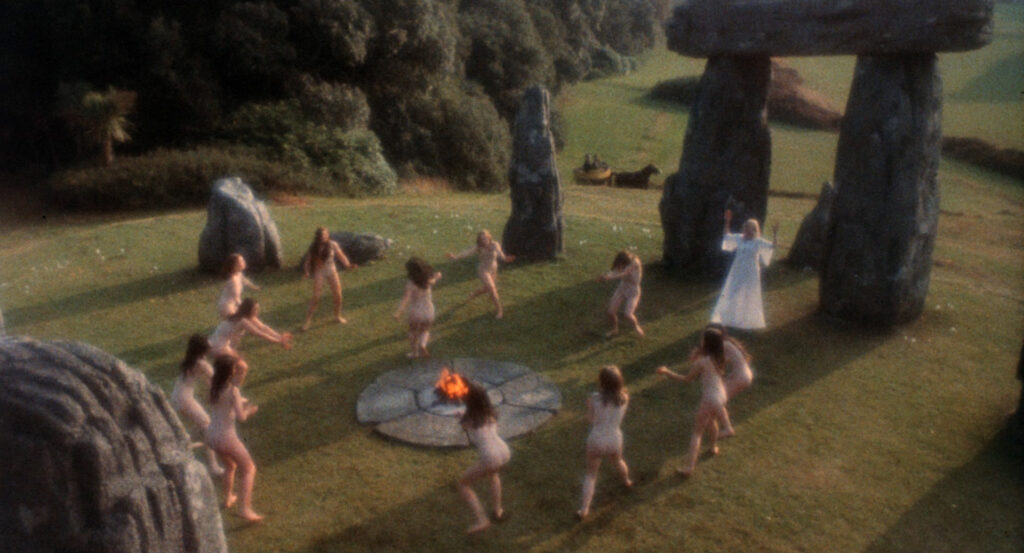
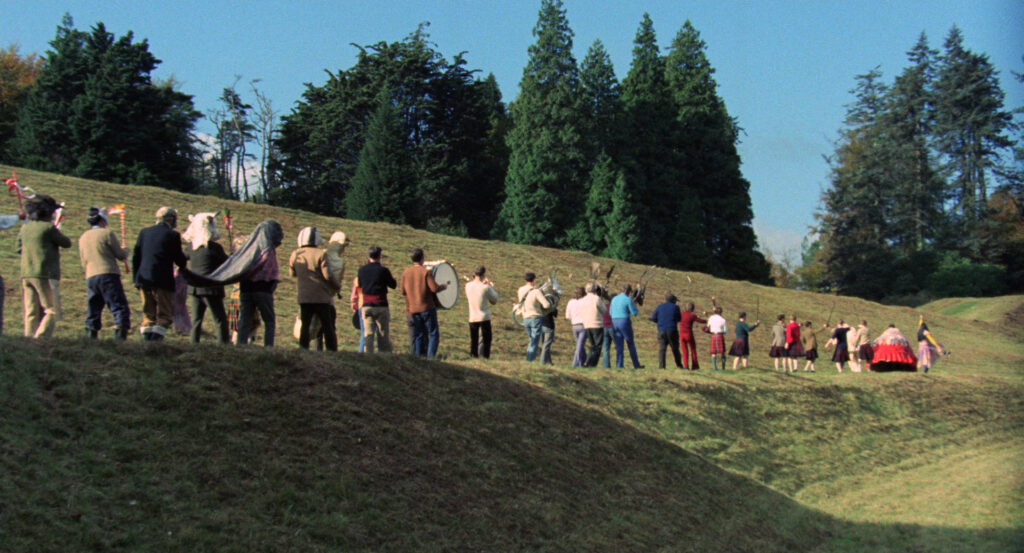
The islanders aren’t hostile, exactly. They’re warm, welcoming, and faintly amused by this uptight mainland cop who can’t understand why anyone would live this way. That warmth, that politeness, that patience — it’s somehow the most frightening thing about them.
And then there’s the ending. One of the most iconic, shocking, and genuinely disturbing conclusions in British cinema history. No spoilers — but once you’ve seen it, you’ll never forget it.
Why The Wicker Man (1973) Has Lasted 50 Years
It helped define folk horror as a genre. Alongside Witchfinder General (1968) and Blood on Satan’s Claw (1971), The Wicker Man is part of what critics now call the “Unholy Trinity” of British folk horror — a loose movement of films that drew their horror not from monsters or the supernatural, but from isolated rural communities, ancient ritual, and the terrifying possibility that the world outside modern civilization operates by completely different rules. Without The Wicker Man, there’s no Midsommar, no The Ritual, no Hereditary in quite the same way.
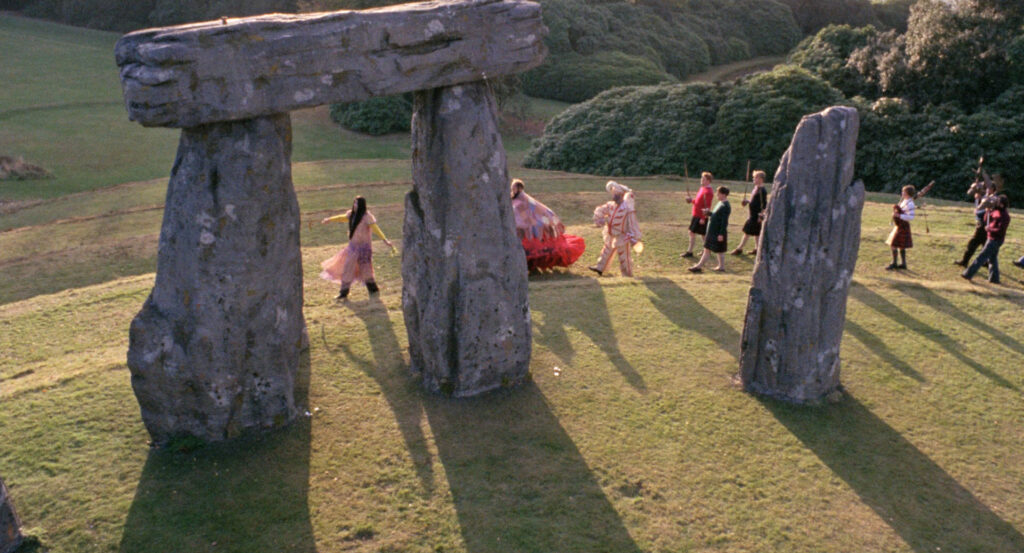
Christopher Lee gives one of the great performances of his career. Lee — who spent much of his career as Dracula and various other monsters for Hammer Horror — was so passionate about this film that he worked on it for free, calling it the best film he ever appeared in. He plays Lord Summerisle, the charismatic, cultured, genuinely charming aristocrat who rules the island and presides over its pagan traditions, and he plays him not as a villain but as a true believer — intelligent, gracious, and completely, serenely certain that what he’s doing is right. That moral confidence is what makes him so deeply unsettling.
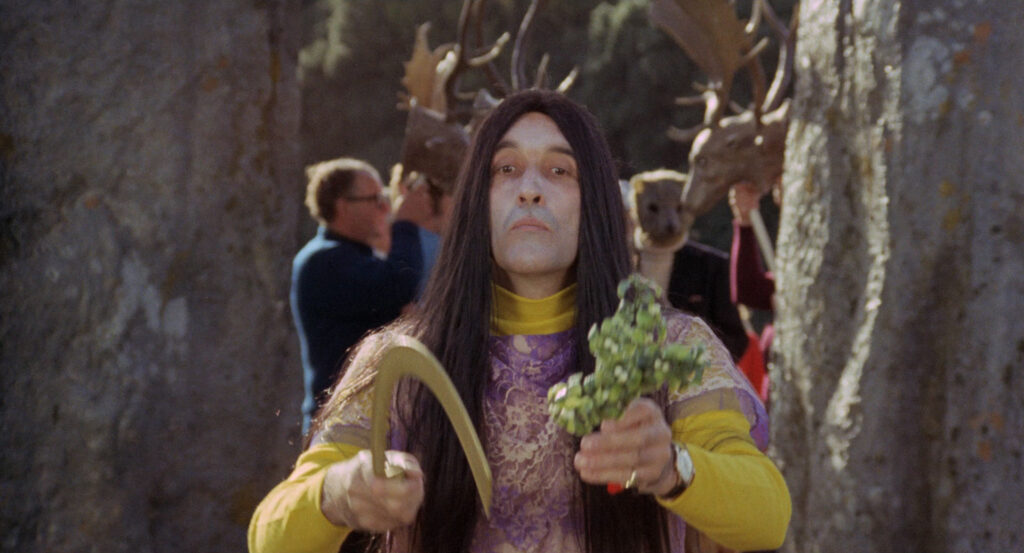
The music is doing something completely unique in horror. Paul Giovanni composed a soundtrack of original folk songs performed live on screen by the cast — cheerful, melodic, traditional-sounding tunes about harvest and fertility and the old gods that the islanders sing in pubs, in classrooms, in the streets. It sounds like a pleasant folk album. In context, it becomes deeply, deeply creepy. The disconnect between the cheerful music and what it’s actually about is a big part of what makes the film’s atmosphere so hard to shake.
Edward Woodward’s Howie is an unusual horror protagonist. He’s not particularly likeable — he’s rigid, judgmental, prudish, and quick to look down on the islanders’ customs. But he’s also genuinely principled and sincerely trying to do right by a missing child. The film asks you to ride along with someone you’re not always rooting for, and that moral complexity makes the ending hit in a way it wouldn’t if he were simply a good man being wronged.
The clash of worldviews is the real horror. The Wicker Man is ultimately a film about two incompatible belief systems — Christianity versus paganism — and it refuses to cleanly side with either. Howie’s faith is presented as sincere but limiting. The islanders’ paganism is presented as joyful but ruthless. The film doesn’t tell you who’s right. It just shows you what happens when these two worlds collide, and leaves you to sit with the aftermath.
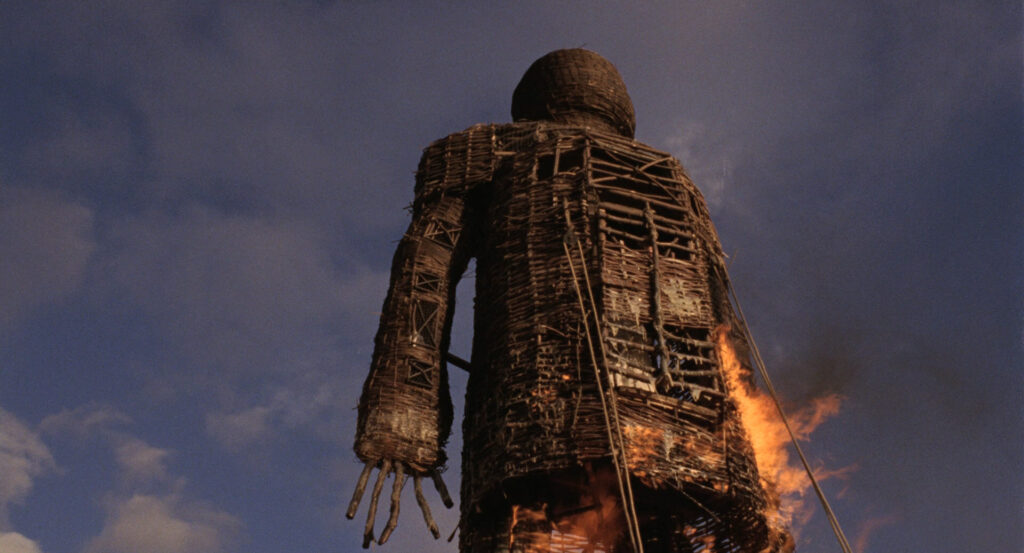
The ending earns its reputation completely. This is one of those rare cases where a film’s famous conclusion actually delivers on its legend. It’s been referenced, parodied, and homaged endlessly — but seeing it for the first time in context, after 80-odd minutes of slow, creeping dread, it lands with a force that’s genuinely hard to prepare for.
The Version Problem
A quick note worth knowing: The Wicker Man has had a complicated distribution history, and several different cuts of the film exist. The original cut was famously butchered by the studio — reportedly, reels of the film ended up buried under a motorway. Different versions have been reconstructed over the years, ranging from around 84 to 99 minutes.
The most commonly available version today is the “final cut” released in 2013, which restores as much footage as possible from various surviving sources. The essential film is the same in all versions, but the longer cuts add character development and context that strengthen the overall experience. If you have the choice, go for the longer version.
The Reception
The Wicker Man had an infamously troubled release — British Lion Films was in financial difficulty, the studio had little faith in the film, and it was initially released as the lower half of a double bill. Director Robin Hardy and star Christopher Lee lobbied for years to get it properly distributed.
Despite this rocky start, the film found its audience through word of mouth and late-night screenings, building a devoted cult following through the 1970s and ’80s. It was eventually recognized as a masterpiece of British cinema, and today holds a very strong critical reputation — regularly cited as one of the greatest British films ever made and one of the defining works of the horror genre.
Cinefantastique magazine famously called it “the Citizen Kane of horror films” in the 1970s, and while that’s a bold claim, it captures something true about how the film operates on a completely different level of craft and ambition from most of its contemporaries.
It was remade in 2006 with Nicolas Cage in the lead role. The less said about that, the better — though it has its own cult following for entirely different reasons.
The Legacy
The Wicker Man didn’t just launch a genre — it defined one. Folk horror as a critical category owes its existence almost entirely to this film, and the wave of folk horror revivals in the 2010s and beyond (Midsommar in particular draws direct, obvious comparisons) brought renewed attention and appreciation to the original.
The film is now studied widely in British cinema and horror film contexts, discussed for its anthropological interest in Celtic paganism, its musical approach, its ideological ambiguity, and its still-startling ending. Christopher Lee spoke about it with pride until the end of his life.
It also helped establish the idea that horror set in daylight — in green fields and sunshine, among friendly, smiling people — can be more disturbing than any darkness or fog. That idea has proven extraordinarily durable.
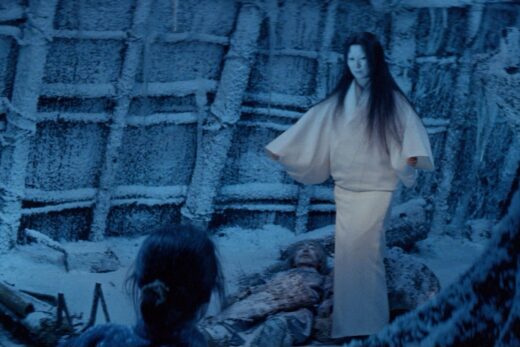
If you’re interested in exploring more landmark horror films from different corners of the world, Kwaidan (1964) offers a haunting collection of Japanese ghost stories rooted in traditional folklore.
Should You Watch It?
Yes — and go in as cold as possible. Don’t read too much about it. Don’t let anyone spoil the ending. Just know that it’s a slow-building, folk-tinged British thriller about a cop investigating a missing girl on a weird island, and let the film do the rest.
It rewards patience. The first half is deceptively gentle, almost pleasant — the horror creeps in so gradually you might not even notice it arriving. And then the ending makes everything that came before it snap into focus all at once.
The Wicker Man is proof that the most effective horror is the kind that makes perfect, terrible sense in retrospect.
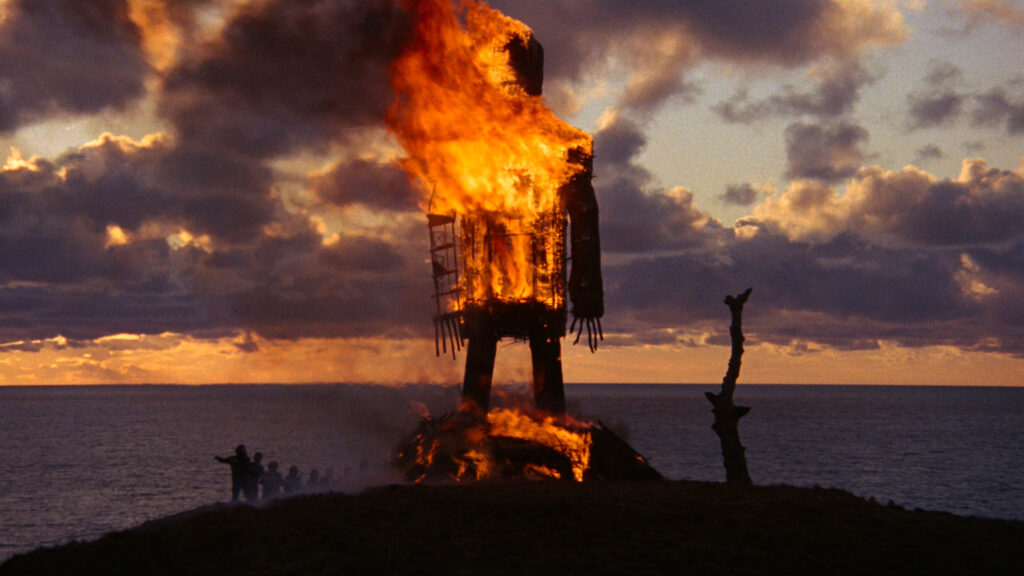
“You’ll simply never understand the true nature of sacrifice.”
— Lord Summerisle, The Wicker Man