Most mysteries end with an answer. Picnic at Hanging Rock doesn’t. Three schoolgirls and a teacher disappear into a volcanic rock formation on Valentine’s Day 1900, and the film never tells you what happened to them. Not even close. And somehow — somehow — that makes it one of the most haunting, hypnotic, and genuinely unsettling films ever made. The mystery isn’t a problem to be solved. It’s the whole point.
The Basics
- Title: Picnic at Hanging Rock
- Year: 1975
- Director: Peter Weir
- Producer: Hal McElroy, Jim McElroy
- Screenplay: Cliff Green, based on the novel by Joan Lindsay
- Stars: Rachel Roberts, Dominic Guard, Helen Morse, Jacki Weaver, Vivean Gray, Anne-Louise Lambert
- Cinematography: Russell Boyd
- Music: Bruce Smeaton (with Gheorghe Zamfir’s pan flute pieces)
- Runtime: 107 minutes
- Genre: Mystery / Drama / Psychological
- Country: Australia
- Studio: Australian Film Commission / South Australian Film Corporation
Source: IMDB
What Is Picnic at Hanging Rock (1975) About?
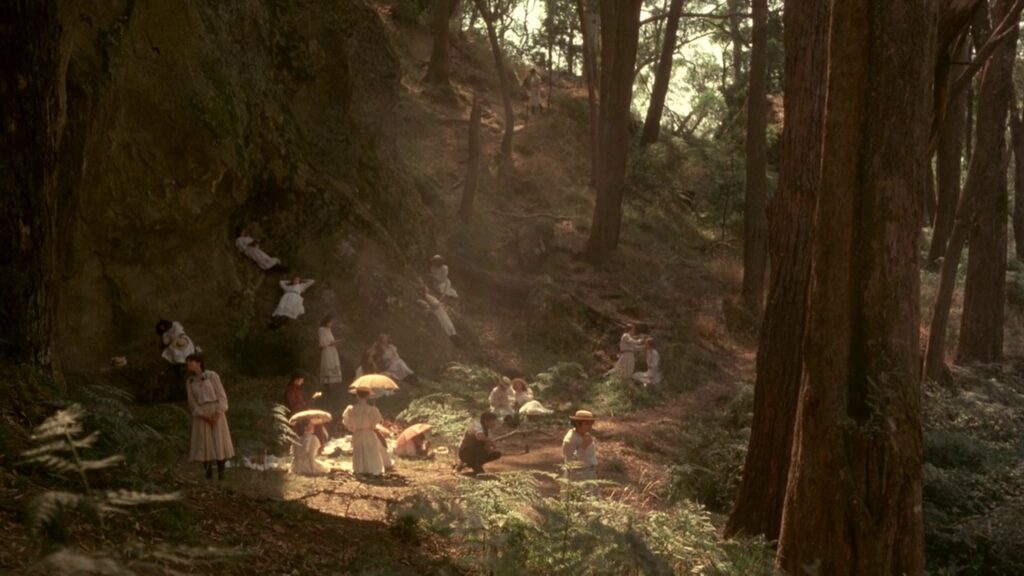
Valentine’s Day, 1900. A group of girls from Appleyard College — a prim, proper boarding school for young ladies in rural Victoria, Australia — go on a supervised picnic to a local geological landmark called Hanging Rock, an ancient volcanic formation rising dramatically out of the flat Australian landscape.
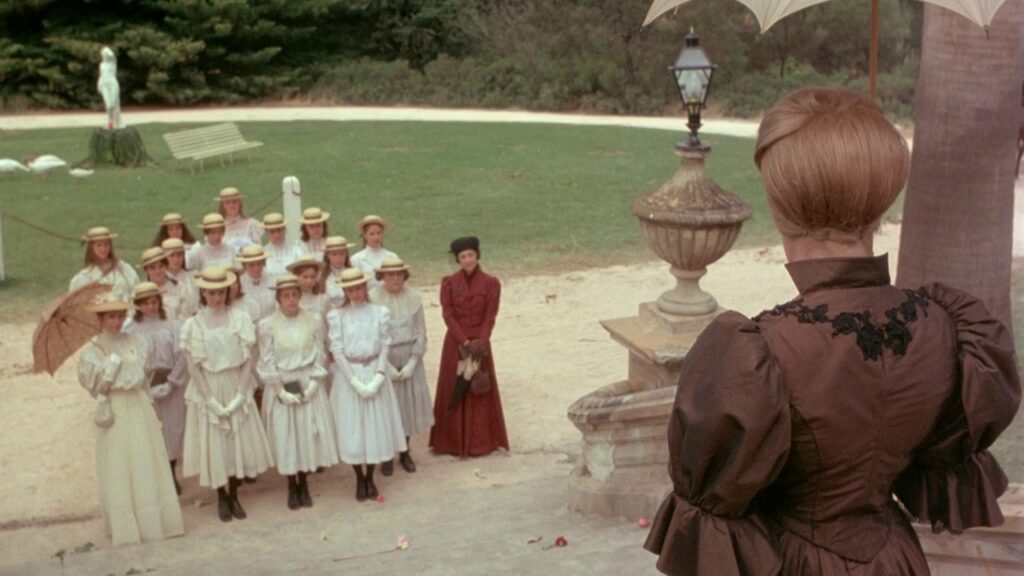
The afternoon is warm, dreamy, unhurried. And then, during a short unsupervised climb up the rock, three girls — Miranda, Marion, and Irma — along with their mathematics teacher Miss McCraw — simply vanish. No trace. No explanation. No sounds of distress. They’re just… gone.
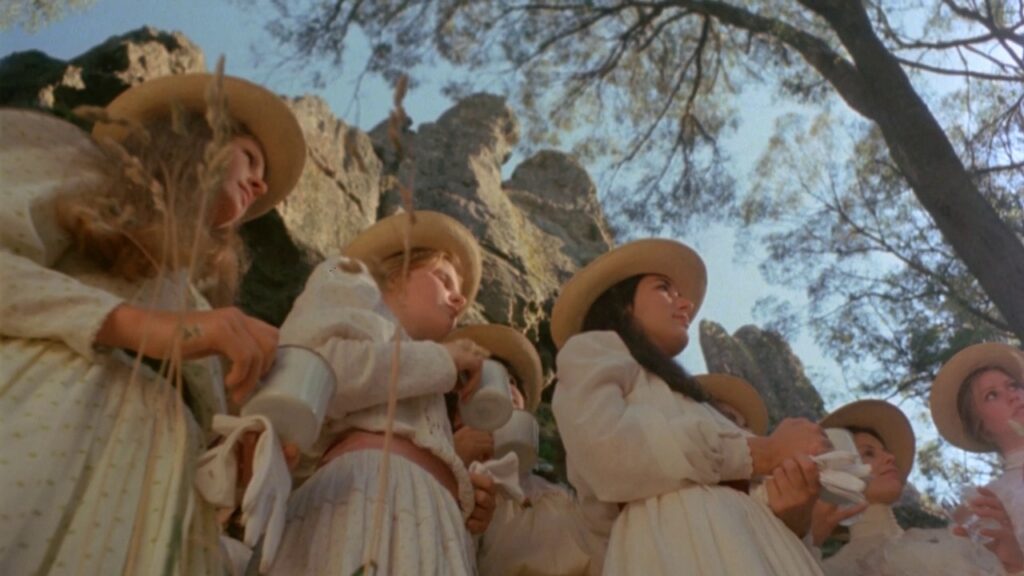
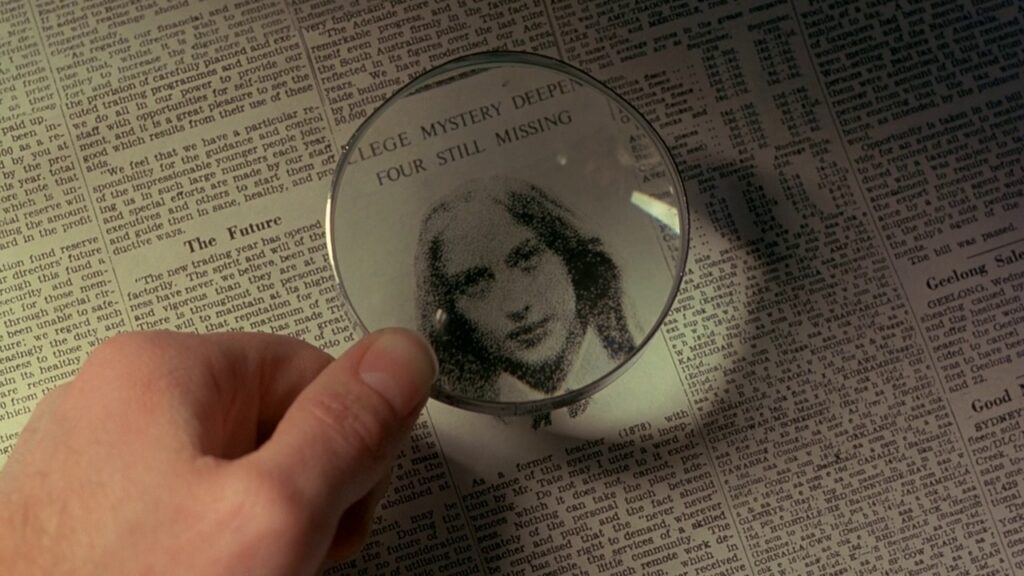
What follows is a slow, aching search — police, search parties, a young English tourist named Michael (Dominic Guard) who becomes obsessed with finding them — while the film never once offers any real explanation for the disappearance.
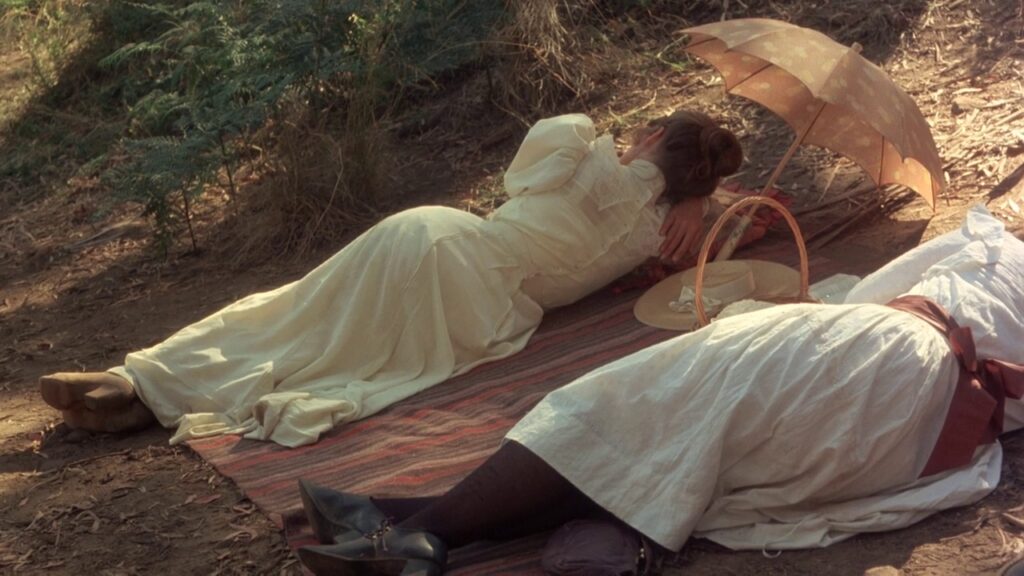
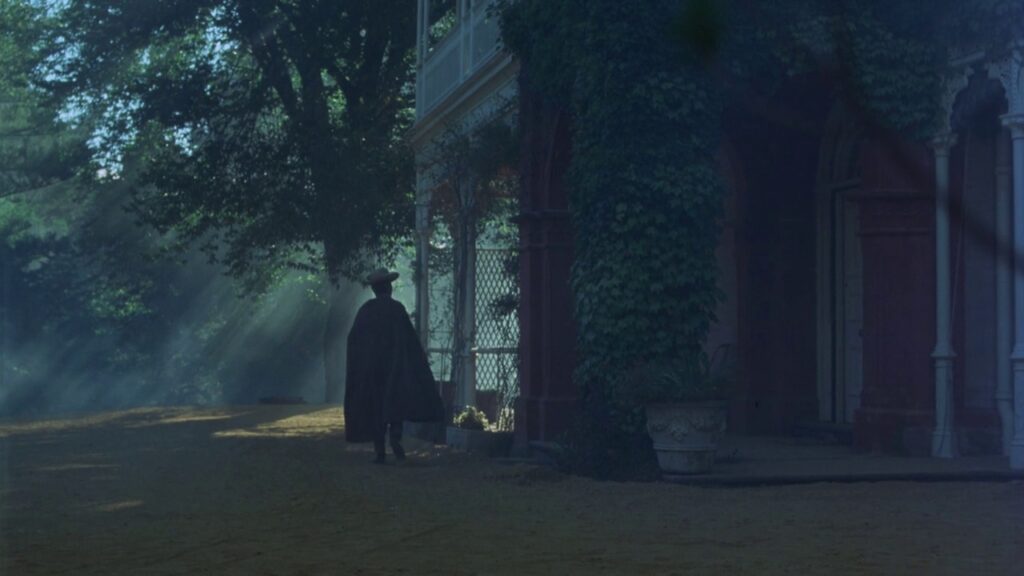
The rest of the film follows the aftermath — the grief, the obsession, the slow unraveling of the school and its headmistress — all without ever answering the one question everyone wants answered: what happened up there?
Why Picnic at Hanging Rock (1975) Gets Under Your Skin
The ambiguity is the film’s greatest achievement. Peter Weir made a very deliberate choice to treat the disappearance as genuinely unexplainable — not as a mystery with a hidden answer, but as an event that exists outside rational understanding. Was it something supernatural? A geological phenomenon? Something the rock itself somehow did? The film doesn’t say, and more importantly, it doesn’t seem to think those are the right questions to be asking. It’s more interested in how people respond to the unknowable than in explaining it.
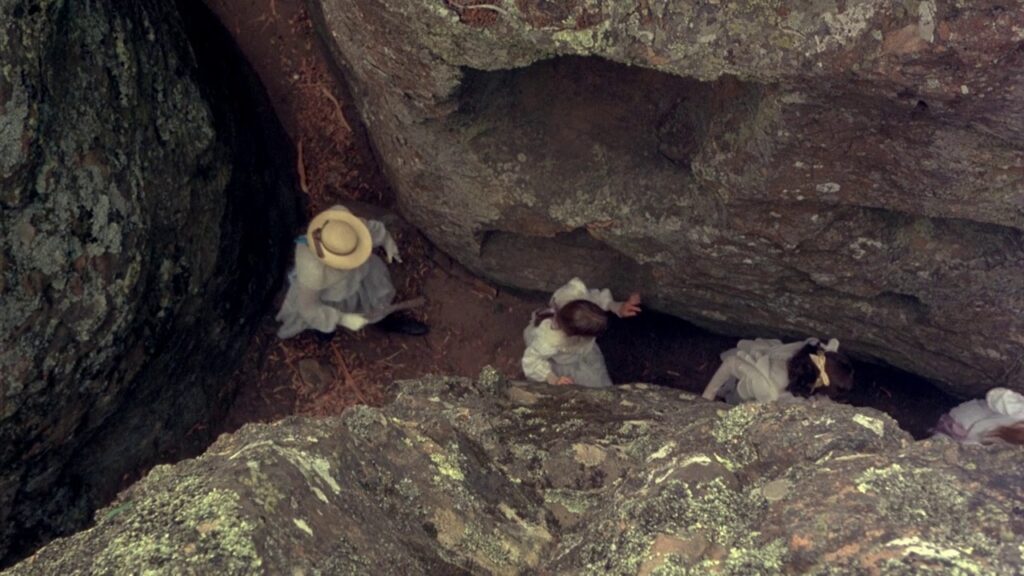
Russell Boyd’s cinematography is some of the most beautiful ever shot in Australia. The landscape here is treated almost as a living entity — vast, golden, oppressively hot, ancient beyond comprehension. Boyd shoots Hanging Rock itself with a reverence and unease that makes it feel genuinely threatening even when nothing overtly threatening is happening. The rock doesn’t do anything. It doesn’t need to. Just being there is enough.
Gheorghe Zamfir’s pan flute. If you’ve seen this film, you already felt something when you read those words. The haunting, breathy, slightly-too-high pan flute music that runs through the film — particularly during the scenes on the rock — is one of the most effectively eerie pieces of music ever used in cinema. It sounds like something between a lullaby and a warning, completely otherworldly and yet also deeply ancient. It’s the sound of the film’s soul.
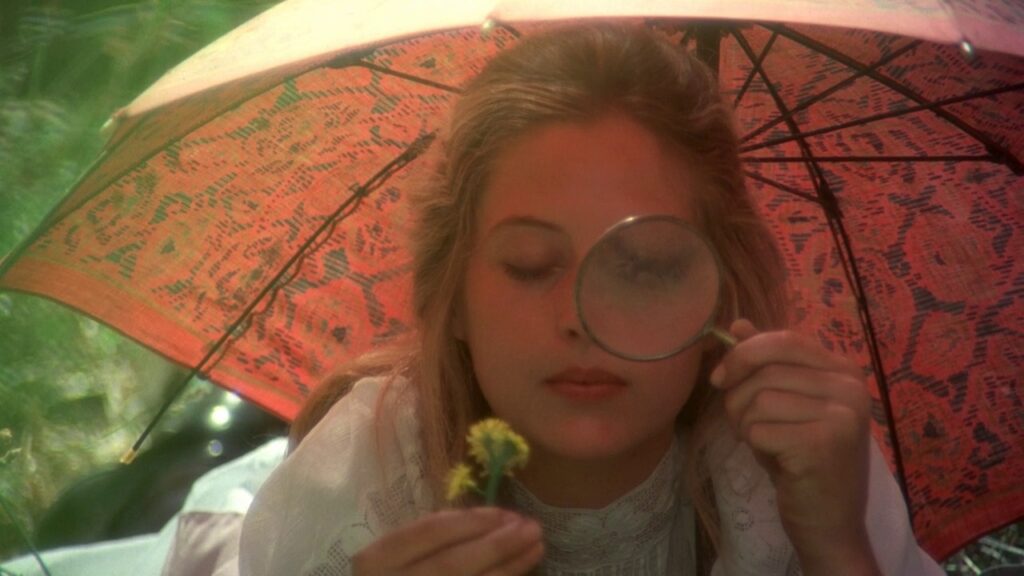
The girls themselves are shot almost ethereally. Anne-Louise Lambert as Miranda in particular is photographed with a soft, gauzy quality — slightly out of focus at times, moving through the landscape as though she exists slightly outside the world around her.. There’s a recurring suggestion in the film that Miranda carries an otherworldly, almost dreamlike quality — someone who never quite feels fully present in the world around her. It’s a strange, haunting characterization, and the film commits to it fully.
It captures something real about colonial anxiety. Set in 1900, the film is very much about the clash between European civilization — the rigid, corseted, rule-bound world of Appleyard College — and the ancient, indifferent Australian landscape that predates European settlement by tens of thousands of years. The rock doesn’t care about propriety or class or the British Empire. It was here long before any of that, and the film implies that what happens on it operates by rules that European sensibility simply cannot comprehend or contain. That subtext gives the mystery a political and cultural weight that elevates it beyond a simple ghost story.
Peter Weir handles the material with extraordinary restraint. There are a hundred ways this film could have gone wrong — too much explanation, too many horror movie conventions, too much melodrama. Weir resists all of them. The film is quiet, slow, dreamy, and trusts the audience completely to sit with unresolved tension without being given a release valve.
The Reception
Picnic at Hanging Rock was a landmark moment for Australian cinema. Upon its release in 1975, it was immediately recognized as something special — a film that announced Australian filmmaking as a serious international force at a time when the country’s film industry was only just finding its footing.
It became one of the defining films of the Australian New Wave — a remarkable period in the mid-1970s to 1980s that produced films like Mad Max, Gallipoli, Breaker Morant, and My Brilliant Career, all of which brought global attention to Australian cinema for the first time. Picnic at Hanging Rock was arguably the film that started it all, proving that Australian stories told in Australian landscapes could resonate internationally.
Critically, it was embraced warmly and has only grown in stature since. It holds very strong critical acclaim and regularly appears on lists of the greatest Australian films and the most significant films of the 1970s. Roger Ebert praised it for creating “an overwhelming feeling of inexplicable dread.”
The Legend of the Novel
Worth knowing: Joan Lindsay’s original 1967 novel on which the film is based was presented in a way that deliberately blurred the line between fiction and fact — many early readers genuinely weren’t sure if the disappearances were a real historical event. Lindsay maintained the ambiguity publicly for years.
She actually wrote a final chapter that explained what happened at the rock — but chose to have it withheld from the original publication. It was eventually published separately in 1987 as The Secret of Hanging Rock. Whether you read it or not is entirely up to you. Some people feel it enriches the story. Others feel it completely misses the point of why the novel and film work so well. Going in having not read the explanation is probably the purer experience.
The Legacy
Picnic at Hanging Rock established Peter Weir as one of the major English-language filmmakers of his generation — he went on to direct Gallipoli, Witness, Dead Poets Society, and The Truman Show, but many consider this early Australian work his purest artistic statement.
The film’s influence on how landscape is used in cinema — particularly in Australian and British filmmaking — is enormous. The idea that a place can be a source of dread without any supernatural trappings, simply through its age and indifference, has become a staple of folk horror and slow-burn psychological drama.
It also remains one of the defining examples of the “unanswered mystery” as a narrative device — proof that withholding explanation can be more powerful than providing one, and that some stories are better left open.
Should You Watch It?
If you can settle into a slow, dreamy, deliberately unresolved film — absolutely yes. Don’t go in expecting answers. Don’t go in expecting scares in any conventional sense. Go in expecting something that feels like a half-remembered dream about something terrible that may or may not have happened, rendered in some of the most beautiful images Australian cinema has ever produced.
Let the pan flute do its thing. Let the rock be what it is. And sit with the not-knowing afterward. That’s the whole experience, and it’s worth every moment of it.
“What we see and what we seem are but a dream — a dream within a dream.”
— Miranda, Picnic at Hanging Rock